
We’re delighted to announce the two winners of an Indonesia Council bursary to support postgraduate attendance at the ASAA conference at Deakin Geelong: congratulations to Tamara Megaw and Trisna Mulyati! Tamara and Trisna were part of a larger cohort of bursary recipients selected by an ASAA sub-committee to support participation in this year’s conference. The award includes a modest cash contribution towards travel costs, generously supplemented by ASAA with complimentary conference registration and conference dinner attendance. Tamara is our postgraduate coordinator and has been featured in a previous edition of our newsletter – you can read more about her work here. Jump to the end to read more about Trisna’s work, as she is our featured Member this month.
And we’re not just supporting postgrads – we’ve also got undergraduates in our sight this year. We’re excited to announce the very first Indonesia Council Undergraduate Day, designed for students interested in Indonesia and wondering where this could take them next. It’s open to undergraduates from all disciplines, not just Indonesian Studies, and also brings with it the chance to attend the Asian Studies Association of Australia conference for free. We warmly encourage you to share this opportunity withy interested undergraduate students – read on for more details. A big thanks to ASAA for supporting this initiative, and to Executive Committee member Elly Kent for pulling it together.
We’ve got a special read this month from journalism student Ting-Jen (TJ) Kuo, who recently participated in the Acicis journalism professional practicum. She has written a fascinating and timely piece on the value of open source intelligence (OSINT) for the modern journalist, particularly in contexts, such as Indonesia, where press freedom is limited. As TJ says, “Buka mata”: it’s time to open our eyes to open source intel.
Our next newsletter is out in June, so please send through any news you’d like to share with us (iclist [at] gmail.com). Do also keep an eye out for separate communications relating to upcoming events and activities, including our Annual General Meeting on 1 July 2026.
Sampai jumpa lagi, Natali and the IC team
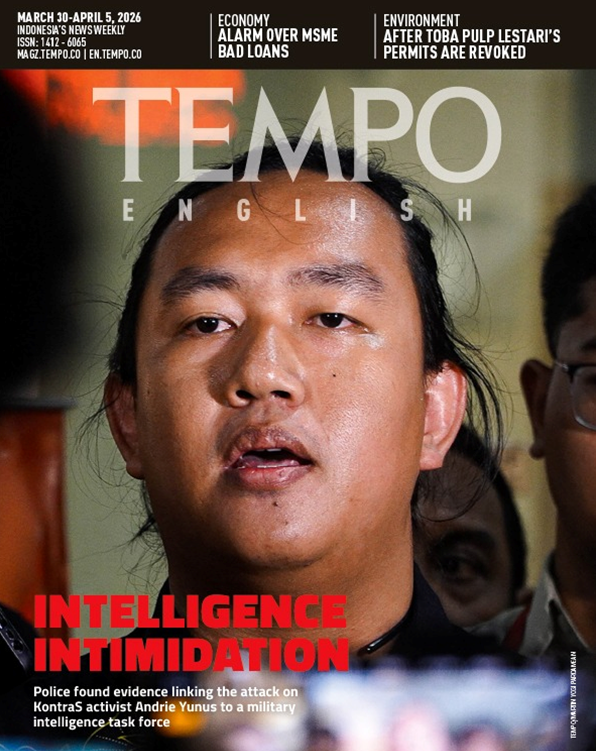
Cover page for Tempo Magazine edition TE2634 – Intelligence Intimidation.
Calls for an impartial investigation
On 12 March, Andrie Yunus, Deputy Coordinator of the Commission for Missing Persons and Victims of Violence (KontraS), was the victim of an acid attack on the streets of Jakarta. Recent reporting by Tempo has linked the attack to a special intelligence task force of the Strategic Intelligence Agency of the Indonesian Military.
Indonesia Council has joined those in calling for an impartial investigation into this attack, which has left Andrie Yunus with serious injuries and raises broader concerns for the safety of Indonesia’s human rights defenders. You can read and sign our petition here.
What’s happening
2026 Westpac Australia-Asia Fellowship recipient
Congrats to IC member Hammad Shahin who has been selected as an inaugural recipient of the 2026 Westpac Australia-Asia Fellowship. Hammad is part of a cohort of 35 emerging leaders, and brings with him a strong and longstanding interest in Indonesia, fostered through a New Colombo Plan scholarship, a number of semester exchanges with Acicis, and a professional internship. He’s also been heavily involved with AIYA, CAUSINDY and AIYEP. You can read Hammad’s recent interview with us here – we are looking forward to seeing where this new opportunity takes him.
Pig Feast – Colonialism in Our Time
Don’t miss the upcoming screening of Pig Feast – Colonialism in Our Time, followed by a panel discussion. The event is organised by PhD candidate Randiano Tamelan and Dr Sophie Chao, both from the University of Sydney’s Discipline of Anthropology, and will be held on 8 May 2026, 3–6 pm. The film and discussion examine the contemporary legacies of colonialism through Indigenous perspectives, inviting critical reflection on extractivism, violence, and resistance in the present.
Other cool stuff
Cultural Amnesia exhibition
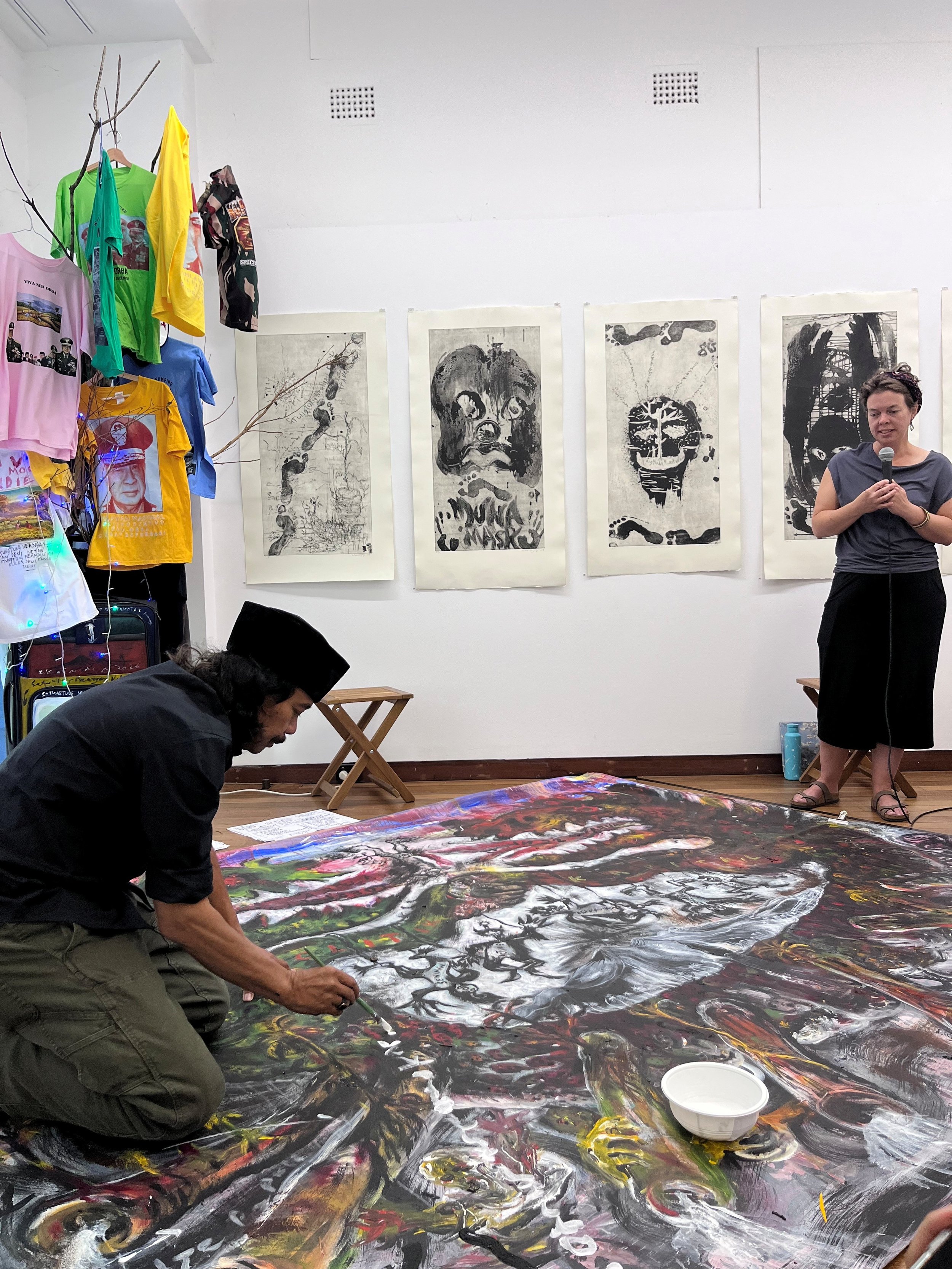
Photo taken during the exhibition's Public Conversation Saturday with Tisna Sanjaya (left) and Dr Elly Kent (right). Supplied.
A recent Sydney Morning Herald article on the radical new wave of Indonesian activist artists reaching Australian audiences resonated strongly with last month’s Cultural Amnesia exhibition at Cross Art Projects, featuring artist Tisna Sanjaya. The exhibition included our very own Elly Kent – author of Artists and the People – in conversation with Tisna through a narrated, performative exchange, translating not only his language but also interpreting for audiences his distinctive blending of individual, participatory, and community‑based approaches to art making.
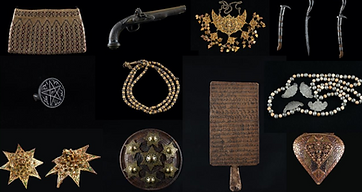
The digitised Aceh Collection from Museum Nasional Indonesia (Google Arts & Culture / Keuneubah Aceh).
Digitising Aceh's historical artefacts
Meanwhile, the National Museum of Indonesia and partners have launched Keuneubah Aceh, a digital exhibition on Google Arts & Culture that traces the hidden histories of Aceh‑related objects held in museum collections—many acquired during the Dutch war in Aceh (c. 1873–1912). Bringing together museum documentation, historical research, and consultation with connected communities, the project addresses incomplete and obscured provenance and situates these objects within the wider machinery of colonial war and collecting.
Chris Hemsworth and jamu
For those who love to watch influencers discovering Indonesia through the lens of wellbeing (or is that just me), check out this recent short doco in which Chris Hemsworth learns all about jamu, in Bali no less – don’t tell the Javanese.
Unmanned underwater drones?
And speaking of the strange things that wash up on Indonesia’s beautiful beaches – there’s plenty of speculation about a torpedo-like object found in waters north of Gili Trawangan. News outlets have speculated it is an unmanned underwater drone linked to a Chinese company. Writing for The Interpreter (“No flag, no crew, no rights –what Indonesia can legally do about the Lombok drone”), Dita Liliansa asked whether this was a ship under international law, and, therefore, whether it was entitled to any navigation rights through Indonesian waters.
Save the dates!
There’s lots to look forward to in coming months, so mark these dates in your diaries:
Indonesia Council Undergraduate Day, Monday 29 June, Deakin University, Geelong Waterfront Campus (VIC, Australia)
The Indonesia Council Undergraduate Day is a one‑day initiative designed for undergraduate students interested in Indonesia and wondering where this could take them next.
The day will include opportunities to meet Indonesia‑focused researchers arts, humanities, law, political and social sciences; workshop emerging research ideas and proposals; and learn more about how to craft your own journey from undergrad to an amazing career in research or beyond.
The program will conclude with an angklung workshop, generously supported by the Indonesian Consulate.
The Undergraduate Day is open to students from all disciplines, not just Indonesian Studies. Register your interest here by 20 May and we will get back to you to confirm all the details.
Participants also have the opportunity to attend the Asian Studies Association of Australia conference at Deakin University Geelong (29 June-2 July) for free if they sign up as an ASAA conference volunteer – more details in the registration form (but note you need to do this by 30 April)!
Registration: $15 for Indonesia Council members.*
Academics are warmly encouraged to share this opportunity with interested undergraduate students.
* DID YOU KNOW? Membership of Indonesia Council is free for all high school and undergraduate students?

Indonesia Council dinner, Tuesday 30 June, Geelong (VIC, Australia)
Members and friends of Indonesia Council are invited to join us for dinner in the margins of the ASAA conference. This will be a pay your own way affair, with all welcome. More details on venue and timing will be provided in the leadup to the conference – in the meantime, please do let us know if you’re interested in attending so we can get a sense of numbers. To do so, click here or scan the QR code before 1 June (don’t worry, this isn’t a formal RSVP and you can always change your mind).
Indonesia Roundtable, Wednesday 1 July (time tba), ASAA conference, Deakin University, Geelong Waterfront Campus (VIC, Australia)
Indonesia Council is pleased to present a roundtable on the research and educational opportunities in Indonesian Studies – a positive take on things after what feels like a lot of doom and gloom in the sector. Featuring members of the IC Executive Committee, speakers will discuss positive experiences of researching and teaching on themes related to Indonesia – including in-country collaborations, language and culture in educational practice, engagement with the Indonesian diaspora and other exciting and emerging avenues to bring Indonesian content into Australian universities. The roundtable is also a space for audience members to bring their own ideas and experiences to the session to celebrate and share examples of successfully contributing to meaningful engagement with Indonesia in universities.
Indonesia Council Annual General Meeting, Wednesday 1 July (time tba), ASAA conference, Deakin University, Geelong Waterfront Campus (VIC, Australia)
More information will be shared with members in accordance with the timelines laid out in our Constitution. In the meantime, do check out what we do on the Executive Committee and be in touch if you’re interested in nominating for a position. This is a great way to contribute to Australia-Indonesia research and education. I’d especially like to draw your attention to the newly created Emerging Leaders Liaison Officer position, designed to serve as a link between the Indonesia Council and younger members, helping share ideas, opportunities, and concerns from emerging cohorts.
Indonesia Council Open Conference, 21-24 June, 2027
Convened by Nathan Franklin at Charles Darwin University, this will be the first ICOC to be held in the Top End (Northern Territory), making it one not to be missed! More information to follow.
Call for Papers
2026 National Colloquium
The Languages and Cultures Network of Australian Universities invites proposals for the 2026 National Colloquium, to be held at the Australian National University on the lands of the Ngunnawal and Ngambri peoples, 23–25 November 2026. Further information on the theme and sub themes, CFP and Speakers list is available here.
9th International Symposium of Journal Antropologi Indonesia
The 9th International Symposium of Journal Antropologi Indonesia (ISJAI) will be held from 4–7 August 2026 at the Faculty of Social and Political Sciences, Universitas Indonesia, Depok. This year’s theme, “Pluriversal Futures in a Multipolarising World: Global South Perspectives,” invites anthropological reflections on shifting global orders, knowledge pluralism, and futures beyond Eurocentric frames. Abstracts of up to 300 words, with five keywords, should be submitted via the UI Open Conference System by 18 May 2026.
Strengthening Australia’s Indonesia Literacy: A roadmap
Supported by funding from the Australia–Indonesia Institute, Joel Backwell has spent the past few years conducting extensive interviews and surveys across education, government, business, and the arts, culminating in a Roadmap that articulates a compelling case for why deeper understanding of contemporary Indonesia is critical to Australia’s future prosperity, security, and regional engagement. He recently presented his recommendations to the House Standing Committee on Education as part of the Parliamentary Inquiry into Building Asia capability in Australia through the education system and beyond. You can see Joel’s appearance before the Committee here (from the 4:56:19 mark) and browse the full Roadmap here
Publications and Podcasts
Indonesia's alternative to dual citizenship
A new Indonesia at Melbourne analysis examines Jakarta’s latest attempt to engage its global diaspora through the Global Citizenship of Indonesia (GCI) visa. While positioned as an alternative to dual citizenship, the scheme has attracted little interest so far, with many overseas Indonesians questioning its cost, limited rights, and lack of political recognition. The authors – Annisa Dina Amalia, Monika Winarnita and Charlotte Setijadi – argue that without meaningful reforms, particularly around citizenship, property rights and participation, Indonesia risks continuing to treat its diaspora as economic contributors rather than fully recognised cultural citizens.
Indonesia's gig economy
A recent article by Meg Hocking for The Interpreter looks at the precarious working and living conditions experienced by Indonesia’s gig-economy workforce. More than 4 million Indonesians are employed as app-based drivers – think Gojek and Grab – but their conditions of employment preclude them from fundamental labour rights and legal safeguards.
Hormuz and Australia’s Indonesian sea lanes
Also for The Interpreter, Aristyo Rizka Darmawan has written a fascinating piece on what the Hormuz crisis reveals about Australia’s Indonesian sea lanes. As he writes, “If there is one thing Canberra has learned from the Strait of Hormuz crisis, it is how vulnerable Australia remains and how dependent it is on the world’s maritime chokepoints. Closer to home, Australia’s reliance on Indonesia’s archipelagic sea lanes presents a similar problem, especially in the event of a future crisis… Indonesia’s straits and archipelagic sea lanes – including parts of the Strait of Malacca, and the Lombok and Sunda straits – carry most of Australia’s trade, with the routes through and around Indonesia accounting for 83% of maritime imports and around 90% of exports. If Indonesia were to close those lanes for any reason, the flow-on effects for Australia would be existential.”
Jacqui Baker on Indonesian police reform
Meanwhile, Tempo featured Indonesia Council past President Jacqui Baker in an interview reflecting on police reform in Indonesia and the role of civil society. Drawing on her long‑standing research, Baker discusses the challenges facing Polri reform and the importance of sustained public accountability in the post‑Reformasi era.
Latest from Talking Indonesia
In a recent episode of Talking Indonesia, “Kramat and the Politics of Indonesian History”, Tito Ambyo spoke with Panggah Ardiyansyah, Research Associate at the University of Sheffield’s Digital Humanities Institute. Drawing on his research on the Islamic complex of Sendang Duwur in East Java, Panggah challenges inherited colonial periodisations of Indonesia’s past and invites listeners to engage with Indonesian antiquities through Indonesian epistemologies. The conversation explores the concept of kramat, sacred space, and what decolonial approaches might mean for the future of Indonesian archaeology.
Latest from The Perantau Podcast
Our Digital Engagement Editor, Billy Adison Aditijanto, is keeping up the great work with The Perantau Podcast, which focuses on sharing stories from Australia's Indonesian diaspora.
The latest episode featured Billy in conversation with Nicholas Alexander Sugianto, co-founder of a tech and AI startup in Melbourne and how optimising AI is his solution to navigate the world's current precarious job market.
Coming up next in May will be an exclusive with Indonesian actor Sekar Sari, currently pursuing a PhD on "Indigenous Intercultural Bodies" at the University of Melbourne, as they talk about research woes, cultural representation through dance, and how having kids flipped her approach to art and research on its head.
Later in June, Billy will host Pipin Jamson, Melbourne-based activist and academic who has been the public face of Melbourne Bergerak, a collective of Indonesian students, workers, activists & allies. They'll talk about Indonesia's dangerous democratic regression, the power of diaspora activism and the risks that come along with it.
Stay tuned for more episodes coming this year and reach out to Billy if you know any interesting guests you'd like to see.
Why OSINT Matters, by TJ Kuo
Most of us had never even heard of open-source intelligence (OSINT) before that afternoon, or ever asked questions like how do you trace a photograph’s origins?
How do you pinpoint the time of day a video was filmed?
How do you cross-reference satellite and street-level imagery?
We quickly learned how crucial a skillset OSINT is for the modern journalist, especially in difficult-to reach and/or dangerous contexts to investigate like Indonesia.
Read the rest of the article here.